
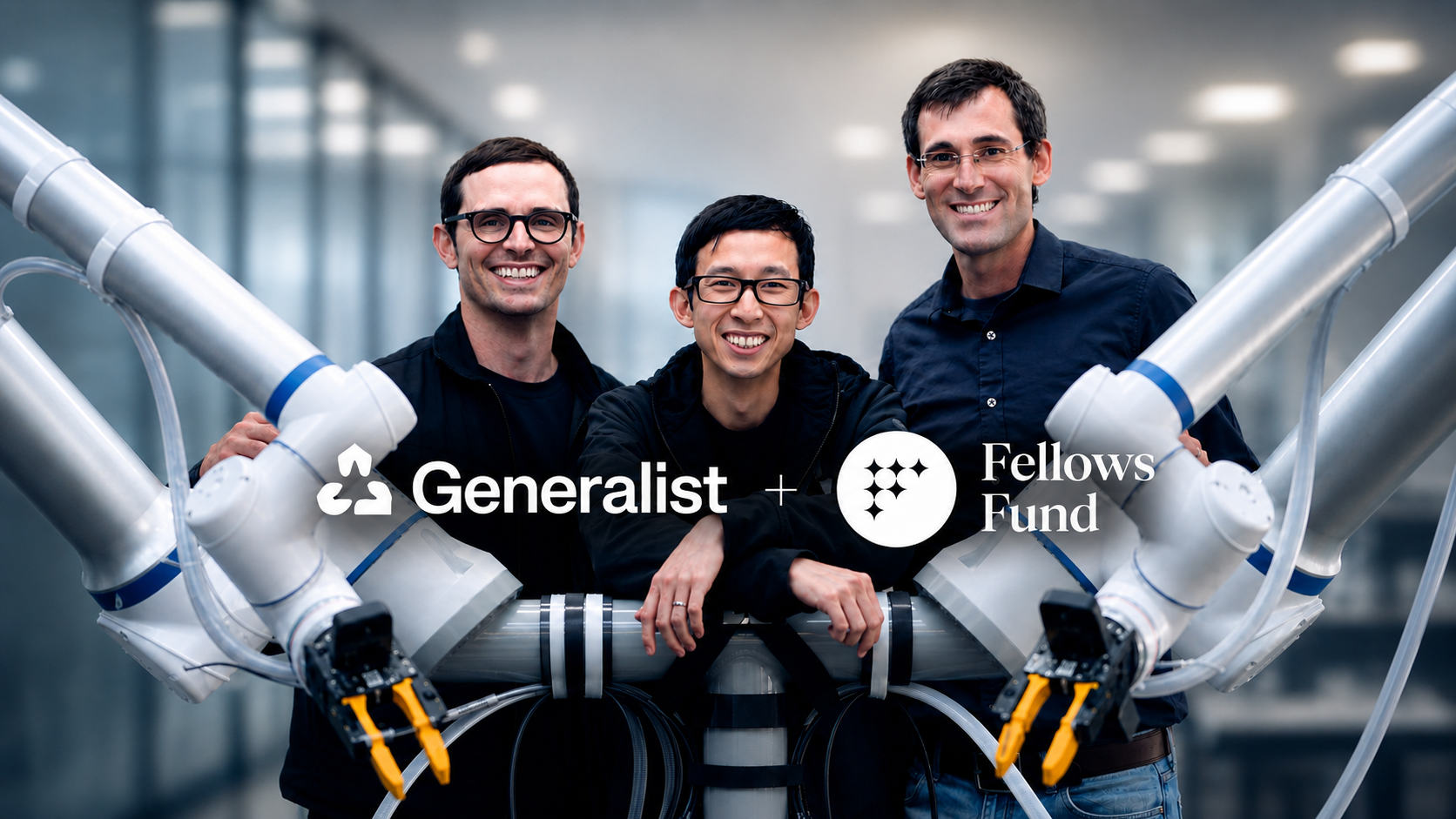
The world runs on physical work.
More than 2.5 billion people work across factories, warehouses, labs, farms, hospitals, construction sites, restaurants, homes, and other real-world environments, representing over $20 trillion in annual labor spend.
Robotics has barely touched this market because the real world does not stay still, and the internet does not contain the physical interaction data robots need.
That is beginning to change. Physical AI is approaching a tipping point as new architectures and data engines start to show that models for the physical world can scale with data and compute. At the same time, hardware costs are falling, robotics is attracting frontier-level technical talent, and capital is concentrating around teams with credible paths to category-defining capability.
As models like Generalist’s GEN series become more intelligent, reliable, generalizable, and steerable, robotics can move from narrow automation toward broad real-world capability. We expect that shift to unlock new use cases across manufacturing, logistics, chemistry, mining, healthcare, food production, infrastructure, home support, and more, expanding the addressable market for automation by orders of magnitude. Generalist is primed to play a crucial role in defining this future.
Why Generalist?
The team: Our network of robotics researchers and leaders was unanimous in its endorsement of Generalist’s team and culture. Pete and Andy co-authored several foundational papers in modern robotics, including PaLM-E and RT-2, and they have built a uniquely focused, high-velocity technical culture that attracts and retains exceptional talent. They understand that winning in robotics requires more than model training: hardware judgment, data operations, controls, infrastructure, evals, deployment discipline, and deep respect for the messy reality of the physical world. Generalist has assembled a rare mix across all those dimensions.
Technical path: Generalist has a history of reasoning from first principles and making non-consensus technical decisions before they become obvious. The company trained a native robotics foundation model from scratch, moving beyond the VLA paradigm Pete helped define, and scaled in-house data collection to more than 500k hours using UMI-style sensorized data. The result is that GEN-1 has emerged as state of the art in dexterous manipulation, reaching 99% average task success across Generalist’s eval suite.
Dexterity: Generalist’s focus from founding has been dexterous manipulation. Picking, folding, inserting, sorting, packing, opening, closing, handling deformable objects, and recovering from mistakes all require contact-rich physical intelligence. Leadership in dexterity means models can add value in the real world now, kicking off a flywheel: deployments create data that can train the next, more capable model. Solve the hardest problem first, commercialize, iterate, and expand outward from there.
Generalist joins a set of Fellows Fund investments in leading research labs across verticals, including Periodic Labs in material science, Harmonic in mathematical reasoning, and more.
We are grateful to partner with Pete, Andy, Andrew, and the Generalist team as they build general intelligence for the physical world.
Investment Team

Alex Ren
Founding Partner

Lucas Sheiner
General Partner

JC Mao
General Partner